
European Free Trade Association (EFTA)
The European Free Trade Association (EFTA) was founded in 1960 with the signing of the Stockholm Convention. The original aim of this intergovernmental organisation was to eliminate tariffs on industrial goods traded between its member states. Today, EFTA serves as a platform for the joint negotiation of free trade agreements.
Information to the Free Trade Agreement
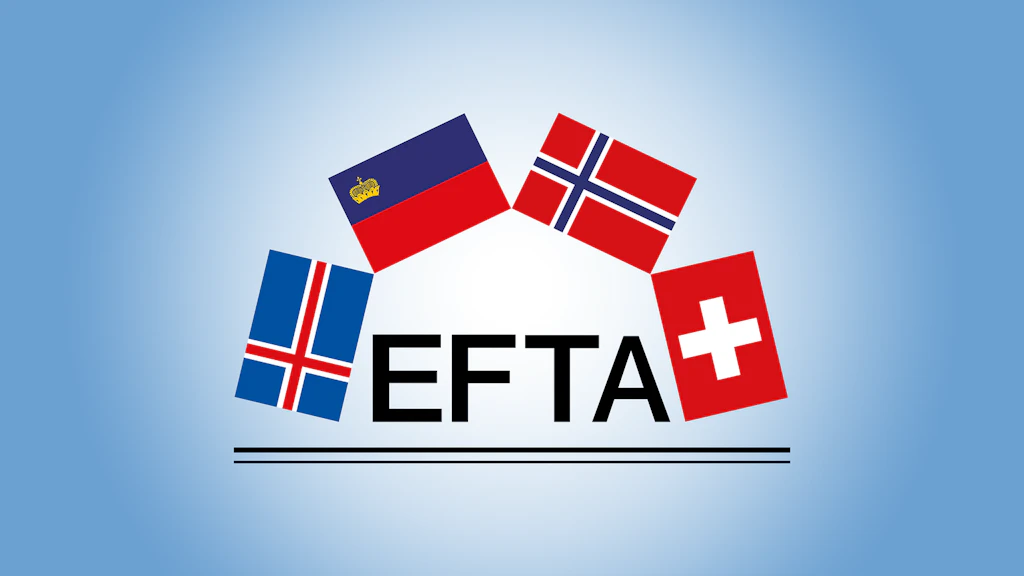
EFTA's current members are Iceland, Liechtenstein, Norway and Switzerland. Unlike the EU, EFTA is not a customs union. This means that individual EFTA states can set their own tariffs and other trade policy measures with respect to non-EFTA countries (third countries).
The EFTA states of Iceland, Liechtenstein and Norway are members of the Agreement on the European Economic Area (EEA). An EFTA Surveillance Authority and an EEA Court of Justice were established to implement EEA obligations.
Since the 1990s, the EFTA states have also used this platform to negotiate free trade agreements with third countries outside the EU.
The EFTA Convention
The European Free Trade Association (EFTA) was founded in 1960 with the signing of the Stockholm Convention (EFTA Convention). The original signatories were Austria, Denmark, Norway, Portugal, Sweden, Switzerland and the United Kingdom. Iceland joined in 1970, Finland in 1986 and Liechtenstein in 1991. Austria, Denmark, Finland, Portugal, Sweden and the United Kingdom are no longer members of EFTA as they subsequently joined the European Union (EU). Current members are Iceland, Liechtenstein, Norway and Switzerland.
Through the Stockholm Convention, the EFTA states established a free trade area for goods among themselves within the meaning of Article XXIV of the General Agreement on Tariffs and Trade (GATT). For many years, the contractual relations between the EFTA states were confined to trade in industrial goods. The Convention was subsequently supplemented by an economic integration agreement covering the services sector within the meaning of Article V of the General Agreement on Trade in Services (GATS).
On 21 June 2001, the EFTA member states of Iceland, Liechtenstein, Norway and Switzerland signed an agreement in Vaduz to update the EFTA Convention.
The Vaduz Agreement replaced the original 1960 founding text in its entirety. The revised EFTA Convention establishes legal relations between Switzerland and the other EFTA states comparable to those under the seven sectoral agreements concluded between Switzerland and the EU in 1999. For example, freedom of movement of persons now applies between Switzerland and the other EFTA states (subject to special arrangements governing movement between Switzerland and Liechtenstein). The Vaduz Agreement also added to the EFTA Convention provisions on trade in services, the movement of capital and the protection of intellectual property.
The Agreement amending the EFTA Convention entered into force on 1 June 2002, simultaneously with the seven sectoral agreements between Switzerland and the EU concluded in 1999. The EFTA Convention has been updated regularly since then, in particular to reflect developments in the bilateral relationship between Switzerland and the EU, including amendments to the 1999 bilateral sectoral agreements and potential new agreements. The aim is to keep the development of treaty relations as closely aligned as possible – both among the EFTA states themselves and between the EFTA states and the EU, covering the bilateral sectoral agreements between Switzerland and the EU, the EFTA Convention and the EEA.
EFTA's third-country policy
Since the early 1990s, the EFTA states have been negotiating free trade agreements with countries outside the European Union. In the first phase, the aim was to avoid the discrimination arising from the EU's establishment of a pan-European free trade zone through its Europe Agreements. During this period, the focus was on concluding agreements with central and eastern European countries. In the mid-1990s, EFTA turned its attention primarily to Mediterranean countries, with a view to participating in the Euro-Mediterranean free trade zone under the EU's Barcelona Process. In doing so, the EFTA states also contributed to promoting economic cooperation in the Euro-Mediterranean region.
As free trade agreements gained in importance in the global economy, the EFTA states began in the late 1990s to extend their free trade policy to potential partners worldwide. EFTA was among the first European organisations to enter into free trade relations with Asian countries. It currently has a network of 35 free trade agreements, with a number of negotiations under way or in preparation.
The EFTA states have also signed declarations on cooperation with various third countries. These declarations typically provide for the establishment of a joint committee, which meets as a rule every 12 to 24 months, and may at a later stage lead to negotiations on a free trade agreement.
The EFTA Secretariat supports the EFTA states in the negotiation and application of EFTA free trade agreements and declarations on cooperation.
European Economic Area
From the outset, one of EFTA's objectives was to regulate relations between its member states and the European Economic Community (EEC, as the EU was then known). A first milestone came in 1972, when the EFTA states individually concluded free trade agreements with the EEC.
From the mid-1980s, economic integration within the EU deepened, driven in particular by the implementation of the single market and the realisation of the four freedoms (persons, goods, services and capital). To enable the EFTA states to participate as fully as possible in the EU single market, the EFTA states and the EU negotiated the Agreement on the European Economic Area (EEA). All EFTA states except Switzerland ratified the EEA Agreement. Austria, Finland and Sweden subsequently joined the EU as full members. Switzerland's accession to the EEA was rejected in a referendum in 1992. Since then, Switzerland has negotiated a series of bilateral sectoral agreements with the EU. The EEA Agreement currently binds the 27 EU member states and the three EEA EFTA states (Iceland, Norway and Liechtenstein).
The EEA Agreement is regularly updated to reflect developments in relevant EU law (the acquis communautaire). Switzerland's EFTA membership also gives it observer status in the EFTA pillar of the EEA, enabling Switzerland to follow developments in EEA and EU law at close quarters.
Index
Press releases
President Parmelin attends EFTA Ministerial Conference in Reykjavik
22 Juni 2026
Related topics
Contact
Foreign Economic Affairs Directorate
World Trade / Free Trade Agreements/EFTA Division
Holzikofenweg 36
3003 Bern