
The International Labour Organization and Switzerland
Switzerland is represented in the International Labour Organization (ILO) by the State Secretariat for Economic Affairs (SECO). The International Labour Organization (ILO), founded in 1919, brings together 187 Member States and plays a central role in the Geneva international community. It is the only tripartite organization within the United Nations system. Governments, employers’ organizations and workers’ organizations work together to develop international labour standards, define policies and design programmes aimed at promoting decent work, social justice and fundamental principles and rights at work.
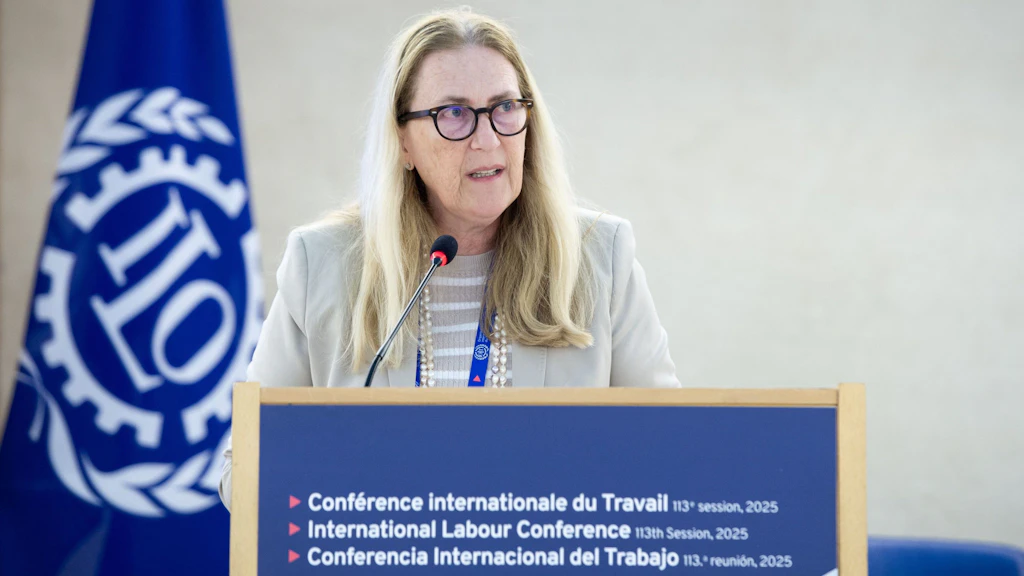
The role of Switzerland
Switzerland plays an active role in this regard. It has ratified 62 conventions, including eight fundamental conventions on freedom of association, non-discrimination, the abolition of forced labour and child labour. SECO regularly monitors their implementation and reports to the ILO.
SECO's DAIN department (International Labour Affairs) coordinates Switzerland’s participation in the ILO and provides the secretariat for the Federal Tripartite Commission, which is responsible for reviewing the ILO’s work, the conventions and their implementation. Together with the social partners, the Swiss government has defined a strategy for Switzerland’s engagement with the ILO to promote social justice.
The fundamental principles and rights at work
Ten ILO conventions are recognised as fundamental, as they give concrete expression to fundamental principles and rights at work: freedom of association and the effective recognition of the right to collective bargaining, the elimination of all forms of forced or compulsory labour, the effective abolition of child labour, the elimination of discrimination in respect of employment and occupation; and a safe and healthy working environment. All ILO Member States undertake to respect, promote and realise these principles, even if they have not ratified the relevant conventions.
This obligation stems from the ILO Declaration on Fundamental Principles and Rights at Work, adopted in 1998 and updated in 2022. It aims to ensure that social progress accompanies economic development and serves as an international benchmark for responsible business conduct. These principles are now incorporated into several global frameworks, including the Tripartite Declaration on Multinational Enterprises, the United Nations Guiding Principles on Business and Human Rights, the OECD Guidelines for Multinational Enterprises, and the United Nations Global Compact.
The ILO’s supervisory system
The International Labour Conference adopts international conventions and recommendations. Conventions become binding upon ratification by a Member State, whereas recommendations provide guidance without being legally binding. Their application is monitored through a unique supervisory system involving governments, employers and workers.
This system is based on three complementary types of procedure. Regular supervision examines reports that Member States submit periodically on the implementation of the conventions they have ratified. These reports are reviewed by an independent committee of experts and subsequently discussed by a tripartite committee of the International Labour Conference. The complaint procedure allows employers’ and workers’ organizations to allege that a Member State is not complying with a convention it has ratified. The complaint procedure, which is more formal, may lead to the establishment of an independent commission of inquiry in cases of serious and persistent violations. Finally, a special procedure examines complaints relating to freedom of association, even if the Member State concerned has not ratified the relevant conventions. Together, these mechanisms promote the effective and progressive application of international labour standards.
Further information
Index
Related topics
Contact
Labour Directorate
International Labour Affairs
Holzikofenweg 36
CH - 3003 Bern