
Non-preferential origin and Preferential origin
The customs tariff distinguishes between non-preferential and preferential origin. Non-preferential origin refers to trade on a most-favoured-nation basis, i.e. without tariff preferences. Preferential origin applies to tariff preferences under free trade agreements (FTAs) or for developing countries (Generalised System of Preferences).
Non-preferential origin
Non-preferential rules of origin are applied where there are no trade preferences, i.e. trade follows the most-favoured-nation principle. They are used to determine the country of origin of goods in order to apply trade policy measures such as anti-dumping duties, trade embargoes or safeguard measures. Often they are also used to compile trade statistics, in public procurement and in the marking of origin.
In Switzerland, the non-preferential origin of goods is determined upon export using the criteria laid down in the Ordinance on the Certification of the Non-Preferential Origin of Goods (CGO, SR 946.31) and in the EAER Ordinance on the Certification of the Non-Preferential Origin of Goods (CGO-FDEA, SR 946.311). At the request of an exporter or a domestic supplier, the certifying body of the competent cantonal chamber of commerce and industry will issue proof of non-preferential origin. This is referred to as certification of origin. The certificate of non-preferential origin must be presented to the competent authority of the importing country upon request.
In many countries, namely those that apply trade policy measures such as the United States or the European Union, the importing country determines non-preferential origin according to its own rules of origin. The exporting country’s non-preferential certification of origin is not decisive in assessing whether such trade policy measures apply to imports to these countries. Switzerland does not currently apply any trade defence measures.
The rules of non-preferential origin should not be confused with those of preferential origin. The latter determine whether trade goods qualify as ‘originating products’ under the preferential system or under preferential agreements and whether they benefit from the tariff preferences of the Generalized System of Preferences (GSP) in favour of developing countries or those of free trade agreements.
Similarly, the rules of non-preferential origin should not be confused with those concerning «Swissness». The legislation on «Swissness» provides better protection for the designation «Switzerland» and the use of the Swiss cross. It contains rules for the use of Swiss indications of source for advertising purposes, helps to prevent the misuse of Switzerland as a brand and preserves its value in the long term.
- SR 946.31
Ordinance of 9 April 2008 on the Certification of the Non-Preferential Origin of Goods (CGO) - SR 946.311
FDEA Ordinance of 9 April 2008 on the Certification of the Non-Preferential Origin of Goods (CGO-FDEA)
- SR 946.31
On 1 July 2022, the revised guidelines concerning the Ordinance on the Certification of the Non-preferential Origin of Goods came into force. The new guidelines seek to harmonise the application of non-preferential origin requirements.
The revised guidelines were drafted by the Federal Office for Customs and Border Security (FOCBS) in consultation with the State Secretariat for Economic Affairs (SECO) and with the involvement of the Swiss Chamber of Commerce and Industry (SCCI) and the trade associations concerned. They streamline certain administrative procedures and improve transparency for users of the non-preferential origin of goods’ system in Switzerland.
Further information as well as the revised guidelines are available on the FOCBS website.
- SR 946.31
Ordinance of 9 April 2008 on the Certification of the Non-Preferential Origin of Goods (CGO) - SR 946.311
FDEA Ordinance of 9 April 2008 on the Certification of the Non-Preferential Origin of Goods (CGO-FDEA) - SR 0.631.21
Protocol of Amendment of 26 June 1999 to the International Convention on the Simplification and Harmonisation of Customs Procedures (with Annexes) (in German) - SR 0.632.20
Agreement of 15 April 1994 Establishing the World Trade Organization (with Annexes) (in German)
- SR 946.31
Preferential origin
Preferential bilateral tariffs are agreed contractually under free trade agreements (FTA). They apply to products that are manufactured entirely in the territory of the state party, or sufficiently worked or processed there to fall within the scope of the agreement. In addition, under the Generalized System of Preferences (GSP) Switzerland unilaterally applies lower duties to products from states it recognises as developing countries.
The origin criteria that these products must fulfil to qualify for preferential tariffs are set out in the origin protocol to the FTA in question (available at this link) or in the Ordinance on Rules of Origin for Preferential Tariffs for Developing Countries (SR 946.39 (in German)).
- FOCBS Developing countries (GSP)
- FOCBS R-30 Free trade agreements, preferential tariffs and origin of goods
Overview of free trade agreements and origin rules
- SR 946.39
Ordinance of 30 March 2011 on Rules of Origin for Preferential Tariffs for Developing Countries (Rules of Origin Ordinance, ROO) (in German)
Cumulation means adding together all of the value creation – such as the production of primary materials or processing at individual stages of manufacture – that is generated in different free trade partner countries. It is used to establish whether a good fulfils the criteria for ‘originating product’ status. Product origin can be cumulated in a number of ways: (i) bilateral cumulation between two parties to a single FTA; (ii) diagonal cumulation between three or more parties to FTAs that apply the same rules of origin; (iii) extended cumulation between three or more partners to FTAs with different rules of origin; and (iv) full cumulation, in which the different stages of manufacture in different parts of a free trade zone are added together.
In 2022 SECO mandated an external study to analyse the economic potential of additional cumulation possibilities in Switzerland's FTAs. The study examines the impact of a form of extended cumulation called “regionalisation of rules of origin”, which consists of three or more free trade partners – all of whom with FTAs in force among them – forming a common cumulation of origin zone. The results show that such regionalisation of rules of origin would have a positive economic impact on Switzerland. It would contribute to a greater use of FTAs and thus allow companies to make additional tariff savings.
Study on the effects of regionalising rules of origin in free trade agreements (available in German only)
Effects of regionalising rules of origin in free trade agreements. Analysis using a multi-country equilibrium model.
PDF1.60 MB7 December 2022
Support document to the external study «Effects of Regionalisation of Rules of Origin in FreeTrade Agreements»
Enhancing the use of free trade agreements through cumulation of origin: the economic potential of the regionalisation of rules of origin
PDF192.10 kB25 January 2023
The «Regional Convention of 15 June 2011 on Pan-Euro-Mediterranean Preferential Rules of Origin» (the «PEM Convention») came into force in Switzerland on 1 January 2012. The object of the Convention is to determine standard rules of origin between PEM partner countries (in German) to ease trade and to integrate supply chains within the zone. The Convention creates a diagonal cumulation zone.
- SR 0.946.31
Regional Convention of 15 June 2011 on pan-Euro-Mediterranean preferential rules of origin (with Annexes) (in German)
- SR 0.946.31
By adopting the PEM Convention in 2011, the parties undertook to revise the old rules from the 1970s that no longer corresponded to today's manufacturing chains. On 7 December 2023 the contracting parties adopted the Revised PEM convention. The revision simplifies the legal framework and certification of origin, permits more flexible supply chains, and thus ensures a better fit between the rules of origin and actual production chains in the PEM zone.
The Revised PEM Convention (SR 0.946.31 (in German)) entered into force on 1 January 2025. It automatically applies to all FTA that contain a so-called “dynamic reference” to the PEM Convention. Further information is availableat this link: Rules of origin of the revised PEM Convention (FOCBS).
- SR 946.39
Ordinance of 30 March 2011 on Rules of Origin for Preferential Tariffs for Developing Countries (Rules of Origin Ordinance, ROO) (in German) - SR 0.946.31
Regional Convention of 15 June 2011 on pan-Euro-Mediterranean preferential rules of origin (with Annexes) (in German)
- SR 946.39
Related topics
9 March 2026
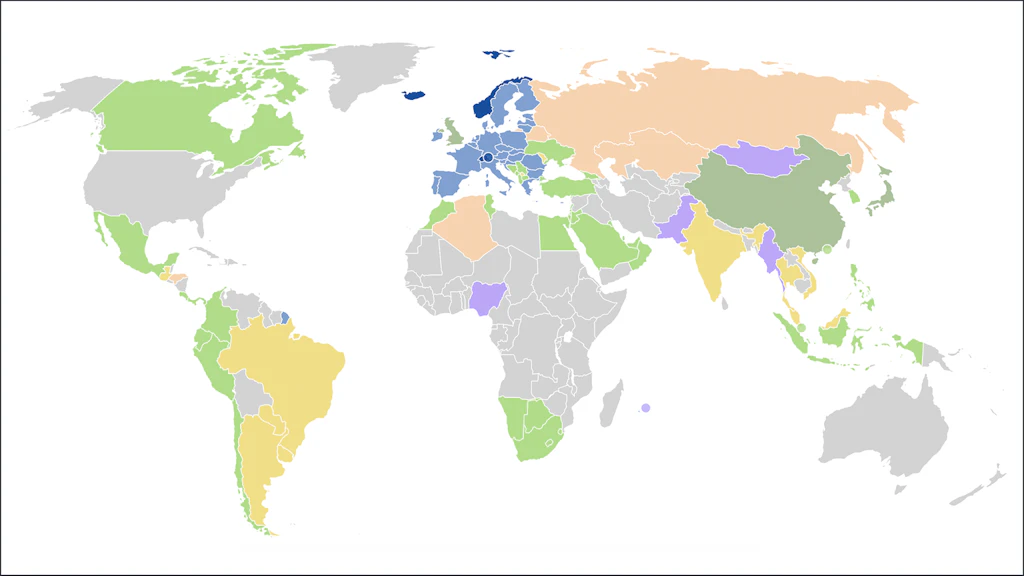
Free trade partners of Switzerland
List of all Switzerland's free trade partners with the legal basis for each country.
Content of free trade agreements
A free trade agreement (FTA) aims to facilitate and promote trade between two or more countries by reducing or eliminating trade barriers. Switzerland's FTAs cover a broad range of subject areas.

Trade facilitation
Trade facilitation measures are designed to simplify customs clearance in order to reduce costs. Switzerland strives to create efficient framework conditions and simple trade procedures.

Use of free trade agreements
The EFTA Free Trade Dashboard summarises the most important information on the use of individual Swiss free trade agreements.
Contact
Foreign Economic Affairs Directorate
Special Foreign Economic Service / International Movement of Goods
Holzikofenweg 36
CH - 3003 Bern