
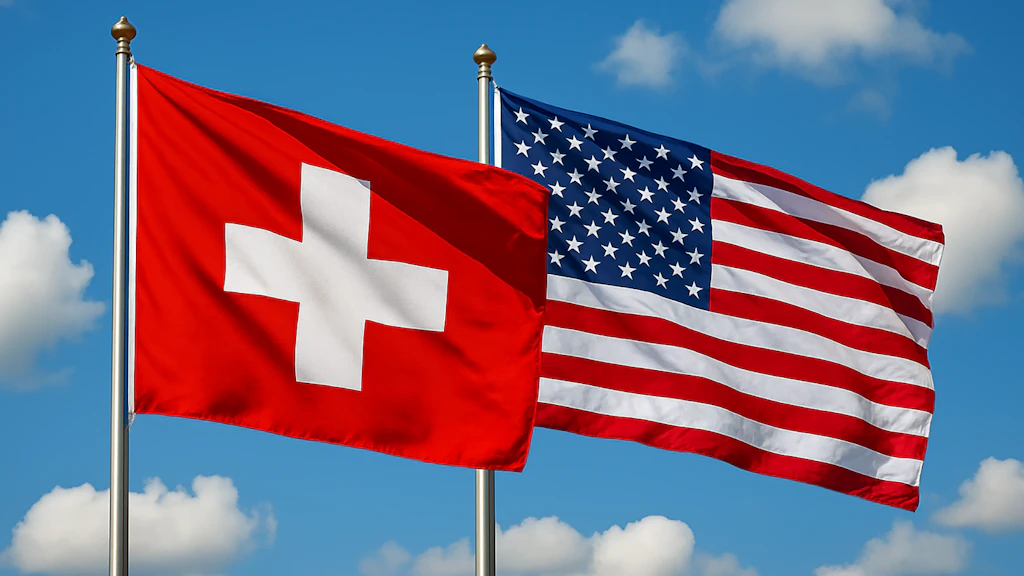
Swiss-US trade relations
On 24 July 2026, the US introduced new additional tariffs following an investigation under Section 301 of the Trade Act of 1974 into trade in goods produced using forced labour. A variable additional tariff of up to 12.5% will be levied on imports from Switzerland, offset by the existing most-favoured-nation (MFN) duty. For example, if the MFN duty on a product is 5%, the new additional tariff will be 7.5%. If the MFN duty is already 12.5% or higher, only the MFN duty is levied. Numerous product categories are exempt from the additional tariffs. These new additional tariffs replace the additional tariffs in force since February 2026 under Section 122 of the Trade Act of 1974, which amounted to 10% on top of the MFN duty. Existing sector-specific additional tariffs remain in force. From 31 July 2026, the US will impose additional tariffs under Section 232 on pharmaceutical products. These will not stack with the additional tariffs under Section 301.
Information and points of contact for affected businesses
- If you have specific questions regarding US import regulations and tariffs on imports from Switzerland, please refer to the information provided by U.S. Customs and Border Protection.
U.S. Customs and Border Protection helpline: traderemedy@cbp.dhs.gov - For further advice in connection with exports from Switzerland to the USA you can contact Export Help at Switzerland Global Enterprise (S-GE):
Tel.: 0844 811 812
Email: exporthelp@s-ge.com
Website: S-GE ExportHelp | S-GE - Import duties on goods from the United States (FOCBS)
- Further information is available from importers, customs brokers and industry associations.
Official information from the US government
- Notice of Actions in Section 301 Investigations of Acts, Policies, and Practices of Various Economies Related to the Failure of Each Economy to Impose and Effectively Enforce a Prohibition on the Importation of Goods Produced with Forced Labor (PDF)
- Proclamation: Imposing a Temporary Import Surcharge to Address Fundamental International Payments Problems
- Customs and Border Protection Guidance: Imposing Temporary Section 122 Duties
- Implementing Certain Tariff-Related Elements of the Framework for a United States-Switzerland-Liechtenstein Agreement on Fair, Balanced, and Reciprocal Trade
- CSMS # 67133044 - Guidance – Implementation of Tariff-Related Elements of the Framework for a United States-Switzerland-Liechtenstein Agreement
Negotiations with the US on a trade agreement are continuing
The legal basis for the additional 10% tariff on top of the MFN duty under Section 122 of the Trade Act of 1974 expired on 24 July 2026. On 23 July 2026, the US announced that this would be replaced by tariffs arising from the Section 301 investigation into trade in goods produced using forced labour.
This means that an additional Section 301 duty will generally apply to Swiss imports to the US as of 24 July 2026, bringing the total US tariff on Swiss goods to 12.5%. If the MFN duty is already 12.5% or higher, only the MFN duty is levied. Numerous product categories are exempt from the new additional tariffs.
Background: On 11 and 12 March 2026, the US launched two investigations against Switzerland under Section 301 of the US Trade Act, which addresses ‘unfair or discriminatory trade practices’. The first investigation focuses on alleged overcapacity in industrial production and its causes, while the second investigation concerns possible failures to impose and effectively enforce a prohibition on the importation of goods produced with forced labour. In addition to Switzerland, a series of other countries, as well as the EU, are affected by these investigations. Switzerland vehemently rejects the allegations raised in the context of these investigations and has submitted written comments on the allegations in both investigations. These are available via the following links:
On 2 June 2026, the Office of the US Trade Representative (USTR) published the findings of its Section 301 investigation into the failure to combat trade in goods produced with forced labour. It concludes that, of the 60 trading partners examined, only some had introduced such a prohibition, and that even those that had done so had failed to effectively enforce it. On that basis, the USTR issued recommendations to impose flat-rate additional tariffs of 12.5% on countries, such as Switzerland, which have not introduced a prohibition on the importation of goods produced with forced labour. For countries with an existing or future import ban, it recommends a tariff rate of 10%. These recommendations were implemented by the decision of 23 July 2026.
The findings and recommendations of the US government from the Section 301 overcapacity investigation have not yet been published and are not known at this stage.
Negotiations with the US on a trade agreement are continuing. In the negotiations, the Federal Council is taking current developments into account and is seeking an outcome that will provide a satisfactory long-term framework for economic relations between the two countries, irrespective of legal and political developments in the US.
On 6 April 2026, new Section 232 additional tariffs on steel, aluminium and copper also entered into force. The additional tariffs range from 10% to 50% and are subject to various country- and product-specific provisions. On 2 April 2026, the US announced the introduction of new additional tariffs on pharmaceutical products with effect from 31 July 2026. An additional duty of up to 15% will then be levied on US pharmaceutical imports from Switzerland. However, there are various product exemptions and company-specific regulations that allow for the import of pharmaceuticals at reduced or zero additional tariffs. The US is thus adhering to the joint memorandum of understanding of 14 November 2025. Negotiations on a trade agreement with the US are continuing. Under the current negotiating mandate, the aim of the ongoing negotiations remains to secure stable conditions for Swiss businesses in the US market and to improve these where possible.
SECO will keep the sectors concerned regularly informed of developments, the application of the new provisions, and the relevant customs classifications.
The provision of binding legal information on US import regulations and tariffs is the responsibility of the relevant US authorities (see contact details for U.S. Customs and Border Protection). The information provided here is for information purposes only.
Questions and answers
Links
- Short-time work compensation in connection with US tariffs (in German)
- Switzerland's Economic Impact in the United States (PDF)
- Exporthelp at Switzerland Global Enterprise
- U.S. Customs and Border Protection
- AS 2025 832
Verordnung vom 12. November 2025 über Einfuhrzölle für Waren aus den Vereinigten Staaten (available in German only) - AS 2025 833
Verordnung des WBF vom 8. Dezember 2025 über die Ursprungsregeln für Waren aus den Vereinigten Staaten (available in German only)
Index
Press releases
Contact
Foreign Economic Affairs Directorate
Bilateral Economic Relations Americas
Holzikofenweg 36
CH - 3003 Bern