
World Trade Organization (WTO)
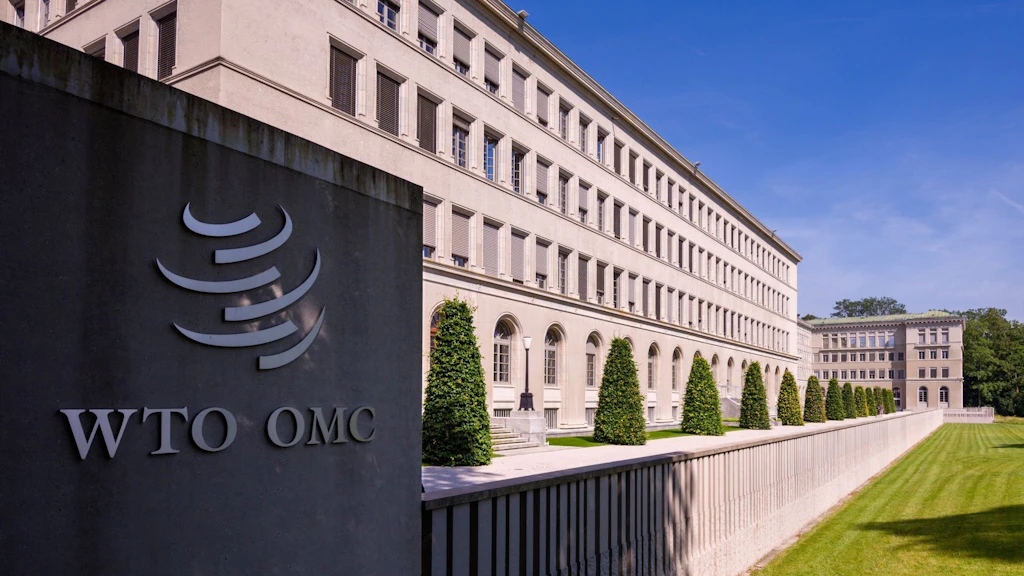
The WTO promotes open, fair and rules-based global trade. It provides a forum for negotiations, monitors compliance with trade rules and settles disputes between members. Developing countries receive special consideration.
What the WTO does
The WTO works to make global trade more open, transparent and fair. It ensures members comply with common rules and regularly publish their trade policies. A key focus is ongoing trade liberalisation – removing tariffs and other barriers, and simplifying customs procedures. This strengthens competitiveness and promotes economic growth, with particular consideration given to developing countries' interests.
The WTO has three main functions:
1. Negotiation forum
The WTO provides a platform for members to negotiate the removal of trade barriers. An ordinary Ministerial Conference is held every two years.
2. Monitoring of rules and policies
The WTO monitors members' compliance with agreed trade rules through committee work, regular reports and trade policy reviews.
3. Dispute settlement
When members disagree about the interpretation or application of WTO agreements, the WTO provides a formal dispute settlement procedure.
Principles
The WTO world trade system is underpinned by several core principles:
Trade liberalisation:
The WTO works to reduce tariffs and other trade barriers, aiming for the freest possible access to international markets while respecting national interests and development needs.
Most-favoured-nation treatment and national treatment:
All WTO members receive equal treatment. Trade advantages granted to one country must be extended to all other members, and foreign products must receive the same treatment as domestic ones.
Transparency and legal certainty:
The WTO requires trade rules to be clear, public and predictable. This builds trust and enables businesses to plan with confidence.
Exceptions and safeguard clauses:
The WTO permits exceptions to its rules in certain circumstances – for example, to protect public health or the environment – subject to specific conditions.
Structure of the WTO
The WTO has 166 members, accounting for around 98% of global trade, with a further 22 countries currently negotiating membership. Decisions are normally made by consensus among all members. The highest decision-making body is the Ministerial Conference, which meets every two years. Below this is the General Council, comprising ambassadors in Geneva or delegates from member capitals. The General Council also convenes as the Trade Policy Review Body and the Dispute Settlement Body.
Three specialised councils report to the General Council: the Council for Trade in Goods, the Council for Trade in Services, and the Council for Trade-Related Aspects of Intellectual Property Rights (TRIPS). Various committees and working groups address specific issues including the environment, development, accession negotiations and regional trade agreements.
Secretariat
The WTO Secretariat, based in Geneva, employs around 600 staff and is currently headed by Director-General Dr Ngozi Okonjo-Iweala. The Secretariat does not make decisions – these are taken by member states.
Its main tasks are to:
- Provide technical support for WTO ministerial conferences, councils and committees
- Advise and assist developing countries, including support for building trade capacity
- Analyse world trade and communicate WTO activities to the public and media
- Provide legal support in dispute settlement proceedings
- Support accession negotiations with prospective members
Switzerland and the WTO
The Swiss economy is closely integrated into the global economy. As a medium-sized economy, Switzerland cannot assert its interests in international trade through economic weight alone – as larger countries or trading blocs can – and therefore depends on clear and reliable rules in world trade.
In line with the Federal Council's foreign economic strategy, Switzerland actively promotes multilateral rules, particularly through the WTO, aiming to open up markets and create a stable, rules-based trading system that offers certainty to businesses and investors.
Together with other WTO members, Switzerland is working on solutions to current trade challenges and is committed to reforms that would strengthen the WTO's negotiating and decision-making functions.
Index
Press releases
No breakthrough at the WTO Ministerial Conference in Cameroon
30.03.2026
Related topics

Multilateral economic relations
Switzerland actively promotes an open, fair, and rules-based trading system, strengthening transparent trade rules and international cooperation through the WTO, the OECD, and new partnerships.

Permanent Mission of Switzerland to the WTO and EFTA
The Permanent Mission of Switzerland in Geneva represents Switzerland at the WTO, EFTA, UN economic bodies (UNECE and UNCTAD) and the ITC. It safeguards Swiss interests and fosters cooperation on global economic and trade issues.
European Free Trade Association (EFTA)
Founded in 1960, EFTA has evolved from a tariff-reduction initiative into a key platform for the joint negotiation of modern free trade agreements.
Contact
Foreign Economic Affairs Directorate
World Trade / Multilateral Economic Relations Division
Holzikofenweg 36
3003 Bern