
CSR Application Tools for Enterprises
CSR helps companies to contribute to sustainability and to identify at an early stage any risks within their value chain that could have a negative impact on sustainability. SECO supports tools that help companies – particularly SMEs – to put responsible business practices into action.

Practical steps and tools for due diligence
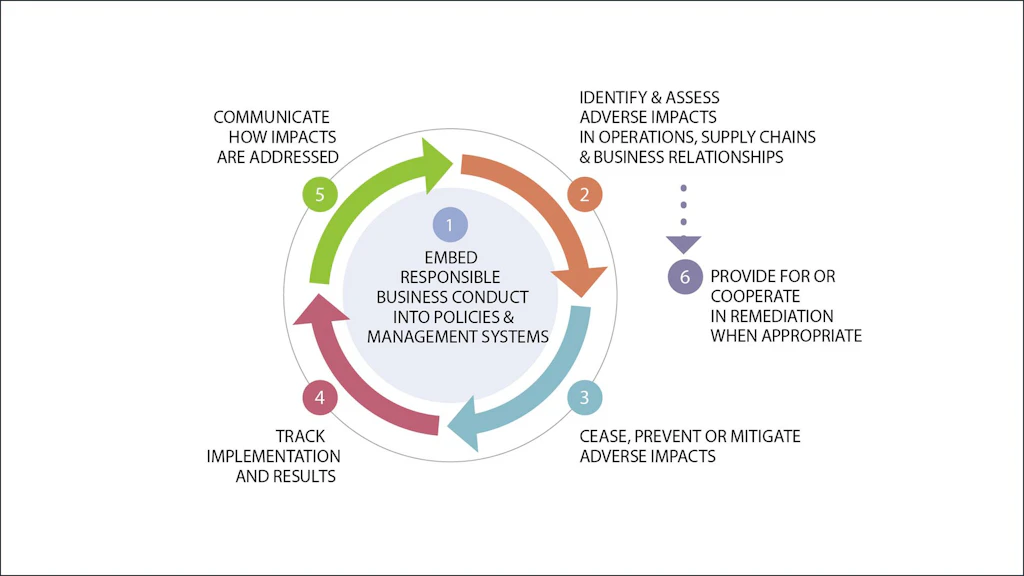
Companies can contribute to economic, environmental and social progress by identifying the actual and potential negative impacts of their own activities and those along their value chain, and by minimising these wherever possible. The OECD Guidelines recommend a six-step risk-based due diligence process for this purpose. The federal government also supports tools for specific issues and sectors. An important aspect of due diligence is ongoing dialogue with the company’s stakeholders, i.e. those affected by its business activities.
Tip for SMEs: SMEs often act responsibly without realising it. Whilst they may have fewer human and financial resources available for due diligence, they are often more flexible when it comes to developing and implementing strategies, and have fewer potential negative impacts and suppliers to take into account. Companies with limited resources can rely more heavily on collaborative approaches when conducting due diligence and must make more careful decisions when prioritising risks.
- SME Sustainability Hub: The Global Compact Network Switzerland offers training and tools to help SMEs assess their impact on sustainability. This includes a handbook that helps SMEs identify and report on key measures in four steps.
- OECD Due Diligence Checker: This self-assessment tool determines whether a company's risk management system complies with the OECD recommendations.
- Practical Guide to Human Rights Due Diligence (PDF): Supports companies in conducting human rights due diligence in accordance with the United Nations Guiding Principles on Business and Human Rights and the OECD Due Diligence Guidelines.
- Agenda 2030 Toolbox for Businesses: Contains practical tools and best practice examples based on the United Nations’ Agenda 2030 and the 17 Sustainable Development Goals enshrined therein.
- Toolkit from the Go for Impact association (available in German only): Filters by guidelines, web-based tools, etc. for sustainable supply chain management.
Step 1: Embed a company policy on responsible conduct
The commitment and leadership of owners and management are crucial to corporate sustainability. Companies should draw up a policy statement on responsible conduct in relation to human rights, labour issues, the environment and the fight against corruption. Responsible conduct should be integrated into all areas of the business and corporate strategies, and become part of the corporate culture. Responsibilities should be defined within internal processes and employees’ areas of responsibility.
Tip for SMEs: Sustainability should be firmly embedded in day-to-day operations, with all relevant departments within the company involved from the outset to enable well-informed decisions. It is also important to inform employees and business partners about the benefits of these efforts so that they actively support the measures. They can make use of existing resources, such as model strategies or publicly available information on risks in specific supply chains. They can also seek technical support from industry associations of which they are members. By adapting relevant guidelines and conducting targeted pilot schemes, successful initiatives can be identified, further developed and scaled up within the company.
- United Nations Global Compact Network Switzerland: Tools and networking opportunities to promote responsible business conduct.
- OECD e-learning Academy on Responsible Business Conduct: Free online training to help you apply risk-based due diligence.
Step 2: Identify and prioritise risks
When developing a strategy for responsible corporate governance, it is important to draw up an overview in order to identify potential risks of negative impacts that the company’s activities may have on society and the environment. To this end, companies analyse their own risks as well as those of their business partners along the value chain. To do this, they use risk indicators for regions, raw materials, products and services. In doing so, they carry out a dual materiality analysis, i.e. they identify the risks and opportunities posed by environmental and social factors for the company, as well as the positive and negative impacts the company has on society and the environment. Companies then prioritise the risks according to severity and likelihood of occurrence.
Tip for SMEs: The nature and scope of a risk analysis depend on various factors, including the size of the company, the context and location of its business activities, the nature of its products and services, and the severity of the actual and potential adverse impacts. Companies with less extensive business activities may not need to carry out a detailed risk analysis before proceeding to the next step of identifying and prioritising specific adverse impacts. In doing so, three to five risks with the highest priority are identified.
- CSR Risk Check: An anonymous, web-based and free tool that identifies potential social, environmental and governance risks for countries and products, and provides recommendations based on international CSR standards for managing these risks. SECO supports the CSR Risk Check.
- Study ‘Environmental Atlas of Swiss Supply Chains’: Identifies hotspots in the supply chains of eight relevant Swiss sectors and measures to prevent or mitigate negative environmental impacts.
Step 3: Eliminate, prevent and minimise negative impacts
Companies develop preventive and corrective measures (e.g. adjusting procurement practices, vetting suppliers and providing training for employees and suppliers). Negative consequences must also be avoided or mitigated even if the company itself has not contributed to them, but they are directly linked to its activities, products or services within the context of a business relationship. Working with a sustainability system or obtaining a label or certification for the management system and products can help to strengthen commitment and make it more visible.
Tip for SMEs: To understand a company’s priorities with regard to CSR, the views of its stakeholders (e.g. employees, suppliers, civil society organisations) are important. These contacts, which are often maintained informally, can be utilised more systematically, for example through ‘mapping’ and a set of standardised questions. These help to systematically assess the potential for value creation – from cost savings and new revenue opportunities to risk mitigation. On this basis, clear objectives are defined and a concrete plan is developed, setting out measures, a timetable and resources. Clearly defined responsibilities and rules for collaboration within the company ensure that implementation is managed efficiently.
- International Social and Environmental Accreditation and Labelling Alliance: A brochure explains how sustainability schemes can support corporate due diligence. The ISEAL Code of Good Practice, the accompanying guidance document and the ISEAL Credibility Principles set out the criteria for credible sustainability schemes. Schemes that comply with the Code are listed under ‘ISEAL Community Members’ and ‘ISEAL Code Compliant’.
- ITC Standards Map: Provides an overview of standards and a classification of sustainability schemes, focusing on their scope of application.
Step 4: Implement measures and assess their impact
Companies implement measures to identify, prevent and mitigate negative impacts. In the context of business relationships, they may also provide support for remediation where appropriate. They review the effectiveness of these measures (e.g. using monitoring systems, supplier assessments, feedback mechanisms or on-site visits) and document progress. An external audit can enhance credibility and increase transparency towards stakeholders. The insights gained from monitoring should in turn be used to improve future processes.
Tip for SMEs: New initiatives should initially be tested in pilot projects in order to learn from early successes and subsequently scale up effective measures in a targeted manner. External partners (e.g. consultants or companies specialising in the relevant field) help to develop a strategy and define the relevant indicators, particularly in the areas of the environment and human resources. Where necessary, we involve them to calculate or certify the results achieved. Based on feedback from stakeholders, the strategy is adapted and new targets are defined.
- Study by the FOEN and SECO: Identifies eleven factors that help Swiss SMEs succeed through the circular economy.
- SME Climate Hub: SMEs can assess their greenhouse gas emissions and take steps to reduce them.
Step 5: Ensuring reporting and transparency
Companies report annually on risks, measures and progress made in identifying and addressing actual and potential negative impacts of their business activities. In their reporting, they may draw on international standards in particular. Finally, the results can be shared internally and externally via targeted communication channels such as the website, publications or briefings, in order to strengthen stakeholders’ trust in the company.
Tip for SMEs: The relevant performance indicators are recorded in a practical manner, using simple tables and existing tools to quickly gain an overview of progress. The annual report documents these developments and serves as an internal management tool.
- European Sustainability Reporting Standard, Voluntary Reporting Standard for SMEs and the corresponding digital template, which can be converted into machine-readable XBRL format.
- Global Reporting Initiative: This reporting framework, based on internationally recognised criteria, comprises principles and indicators for companies and other organisations to measure their economic, environmental and social performance.
- IFRS S1 General Requirements for Disclosure of Sustainability-related Financial Information: A reporting framework for disclosures on how sustainability risks and opportunities affect a company’s financial performance.
Step 6: Make amends
Companies should establish grievance mechanisms for individuals affected by the adverse impacts of their business activities (e.g. employees, third parties). These may be mechanisms operated by the company itself or other grievance systems (e.g. those run by multi-stakeholder initiatives). The mechanisms should operate in a legitimate, accessible, predictable, impartial, transparent and dialogue-oriented manner. If a company determines that it has caused or contributed to adverse impacts, these should be addressed. Companies may also work with partners to provide redress where they have caused or contributed to adverse impacts.
Tip for SMEs: The appropriate form and extent of redress depend on the nature and scale of the adverse effects. For SMEs, setting up internal, independent reporting channels is often challenging. External, low-threshold services (e.g. provided by industry associations) offer a viable alternative. These are generally available for a modest basic fee plus case-related additional costs and ensure that reports are handled professionally and impartially.
Index
Relevant topics
OECD due diligence guidance
The guidances help companies to carry out risk-based due diligence in order to address potential adverse impacts arising from their operations, supply chains and business relationships.

Key areas of corporate sustainability
CSR encompasses a wide range of issues that must be taken into account in business management.
Sector-specific CSR
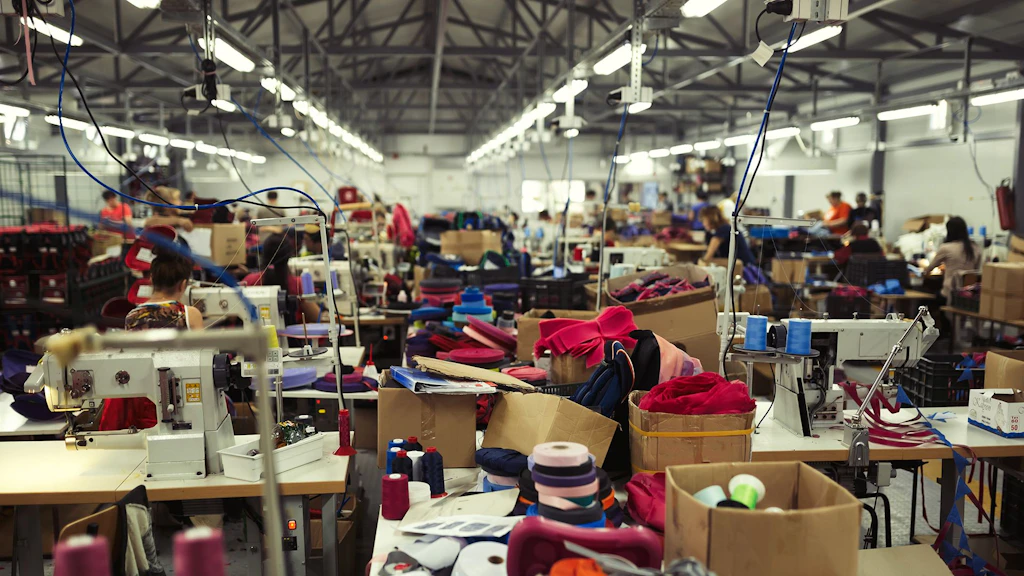
Some sectors face particular challenges regarding corporate sustainability, which is why specific instruments provide targeted support for responsible business conduct.
Contact
Foreign Economic Affairs Directorate
Special Foreign Economic Service / International Investment and Corporate Sustainability
Holzikofenweg 36
CH - 3003 Bern