
Sector-specific CSR
Some sectors face particular CSR challenges, which is why sector-specific instruments provide targeted support for responsible business conduct. Companies operating in areas where states largely fail to fulfil their regulatory responsibilities also face major challenges. The federal government promotes sector-specific instruments.
Commodities sector
Commodities – and the supply chains connecting them to global markets – are vital to local economies and essential for the green transition and strategic industries. The federal government supports the following instruments and initiatives in particular, covering human rights, the environment as well as anti-corruption:
- The Commodity Trading Sector Guidance on Implementing the UN Guiding Principles on Business and Human Rights assists with due diligence (see article Guidance aims to ensure human rights in commodities trading, available in German only)
- OECD due diligence guidance for responsible mineral supply chains: A guidance document for companies operating in conflict-affected and high-risk areas helps them carry out supply chain due diligence and avoid indirectly fuelling conflicts or contributing to human rights violations (incl. when extracting and trading tin, tantalum, tungsten and gold). A further guidance document supports companies in the mining, oil and gas industries in taking stakeholder interests into account (e.g. local communities, workers, artisanal miners). A handbook helps integrate environmental considerations into due diligence in the mineral supply chains.
- Extractive Industries Transparency Initiative: The initiative improves transparency around payments made to governments of resource-producing countries by extractive companies working with minerals, gas and oil.
- Artisanal Small-Scale Gold Mining: The Swiss Better Gold Association project, based on a public-private partnership between SECO and the Swiss Better Gold Association, aims to make artisanal gold mining more sustainable.
Agricultural sector
Responsible investment in agriculture and the agri-food industry is essential to securing global food supplies. The following instruments help companies carry out due diligence across their value chains to prevent potential adverse impacts on society and the environment:
- OECD-FAO Guidance for Responsible Agricultural Supply Chains: This guidance helps companies operating in agriculture and related products to fulfil their due diligence obligations. The OECD-FAO has also published a specific handbook on deforestation.
- Swiss Platform for Sustainable Cocoa: This multi-stakeholder initiative works to improve the living conditions of cocoa farmers and protect natural resources in cocoa-producing countries.
- Swiss Platform for Sustainable Coffee: This multi-stakeholder initiative promotes greater sustainability across the coffee value chain.
- Soy Network Switzerland: This industry initiative promotes responsible cultivation and sustainable sourcing of feed soya.
- Palm Oil Network Switzerland: This network brings together key players in the food industry to promote the cultivation, processing, marketing and use of sustainable palm oil and palm kernel oil.
Financial sector
The financial sector's diverse investment activities and complex business models create particular risks of adverse impacts on society and the environment.
- OECD Due Diligence Guidance for Responsible Business Conduct in the Financial Sector: The OECD has published due diligence instruments for the financial sector, covering institutional investors and banks, among others.
- State Secretariat for International Financial Matters: The federal government engages with financial institutions on sustainability issues and advocates for an optimal regulatory framework (incl. for example, climate reporting).
- Swiss Sustainable Finance: This Swiss association works to position Switzerland in the global sustainable finance market and provides a platform for exchange.
Security sector
In armed conflicts and areas where the rule of law is under threat, states and companies often engage private military and security companies to perform security functions.
- Montreux Document: Provides an overview of the international law obligations of private military and security companies operating in armed conflicts.
- International Code of Conduct for Private Security Companies: Companies can commit to respecting human rights and international humanitarian law in areas where the rule of law is under threat.
- Toolkit: Addressing Security and Human Rights Challenges in Complex Environments: Sets out good practices for engaging with public security forces and private security providers.
- Voluntary Principles on Security and Human Rights: The Principles help companies assess risks and take measures to ensure that human rights are respected when engaging security companies, military and police.
Textiles and footwear sector
The textiles and footwear sector is one of the world's largest consumer goods sectors. Companies may face risks of adverse impacts on society and the environment in their own operations or value chains.
- The OECD guidance documents assist with due diligence to promote responsible supply chains in the clothing and footwear industry. The guidance has been written to help companies identify, mitigate and report on potential risks. A self-assessment tool allows companies and sustainability initiatives to check whether they are implementing the recommendations set out in the guidance.
- Sustainable Textiles Switzerland, a multi-stakeholder initiative, aim to make a significant contribution to achieving the UN Sustainable Development Goals in the Swiss textiles and apparel sector across the entire value chain.
Tourism sector
The federal government supports various sustainable tourism initiatives through its tourism policy and Innotour projects (available in German only).
- The Swisstainable (available in German only) sustainability programme has three levels to reflect the different requirements and committments of businesses (z.B. EarthCheck). Participating companies will be awarded the Swisstainable logo.
- Sustainability Centre of Competence (KONA) (available in German only): As a national point of contact and coordination body, KONA promotes the sustainable development of Swiss tourism.
Index
Related topics

Commodities
Switzerland is one of the most important locations for the international raw material industry. Companies cover a broad range of commodities and business activities and strengthen employment as well as the country’s economic performance.
OECD due diligence guidance
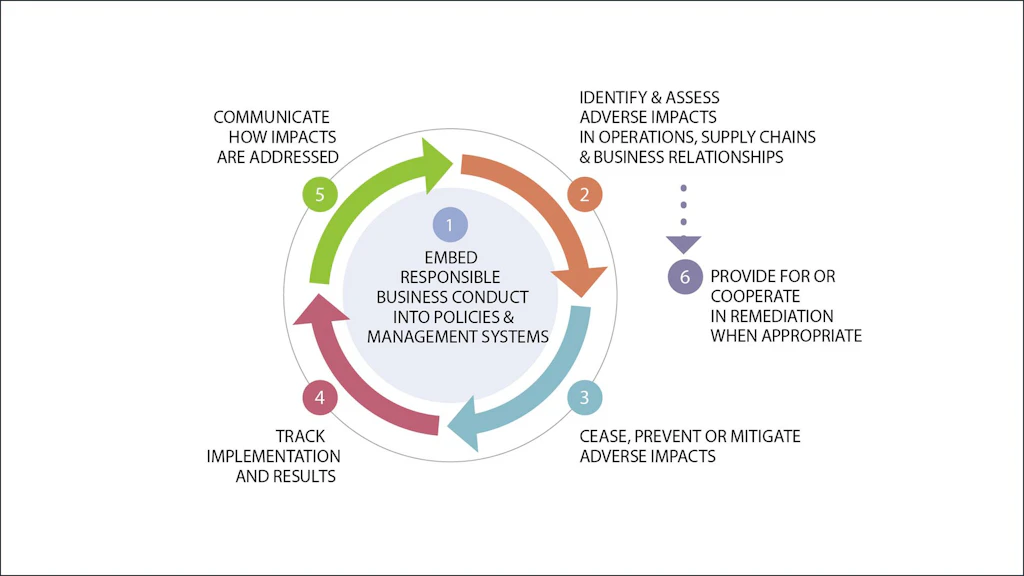
The guidances help companies to carry out risk-based due diligence in order to address potential adverse impacts arising from their operations, supply chains and business relationships.

CSR Application Tools for Enterprises
CSR helps to identify sustainability risks in value chains. SECO supports tools that make it easier for SMEs to operate responsibly.
Contact
Foreign Economic Affairs Directorate
Special Foreign Economic Service / International Investment and Corporate Sustainability
Holzikofenweg 36
CH - 3003 Bern