
OECD due diligence guidance
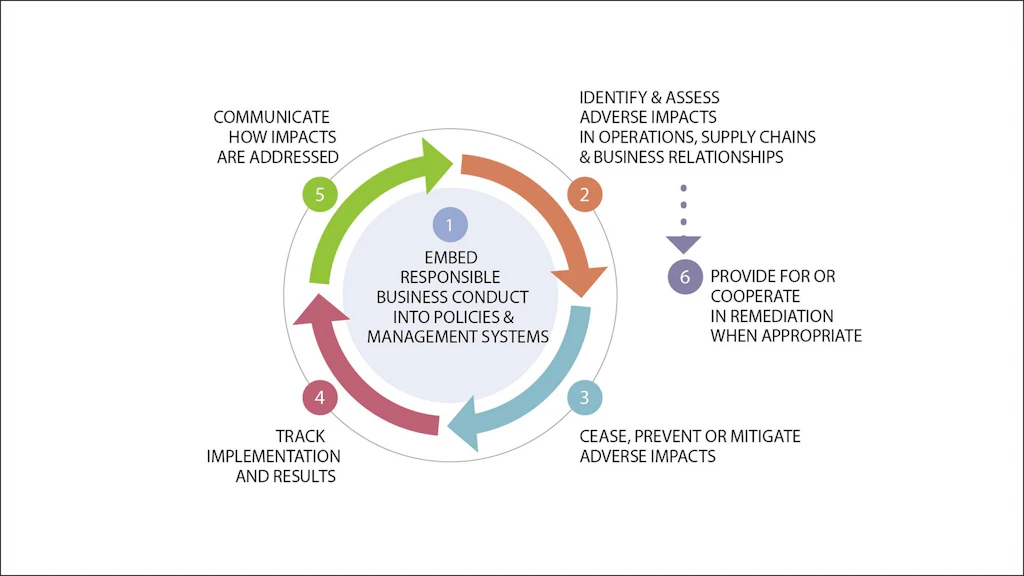
The OECD Guidelines for Responsible Business Conduct include recommendations on carrying out risk-based due diligence. This process helps companies assess and address potential adverse impacts in their operations, supply chains and business relationships. The OECD has developed guidance documents to support companies in putting this into practice.
Guidance for all sectors
The OECD Due Diligence Guidance for Responsible Business Conduct provides practical recommendations for companies on due diligence across their value chains, covering the topics addressed in the OECD Guidelines for Multinational Enterprises on Responsible Business Conduct (including human rights, working conditions, the environment and anti-corruption). The guidance is aimed at all companies with value chain risks, regardless of sector or size, and also serves as a tool for implementing the UN Guiding Principles on Business and Human Rights.
- OECD website: Due diligence for responsible business conduct
- OECD Due Diligence Checker: This self-assessment tool determines whether a company's risk assessment system complies with the OECD's recommendations.
The OECD Due Diligence Guidance for Responsible AI aims to foster innovation, investment and growth along the AI value chain by helping companies address potential adverse impacts.
- OECD website: Responsible business conduct and technology
Sector-specific guidance
Commodities
The OECD Due Diligence Guidance for Responsible Supply Chains of Minerals from Conflict-Affected and High-Risk Areas is aimed at companies in the commodities sector operating in conflict-affected and high-risk areas. It helps them carry out due diligence on their own activities and supply chains and identify risks, so as to avoid supporting conflicts or contributing to human rights violations. The guidance includes two supplements: one on the specific challenges of extracting and trading tin, tantalum and tungsten, and one on gold. The OECD has also published guidance on avoiding adverse environmental impacts in extraction and trade, including in relation to other raw materials such as sand and silica.
The OECD Due Diligence Guidance for Meaningful Stakeholder Engagement in the Extractive Sector supports companies in the mining, oil and gas industries in taking stakeholder interests into account (e.g. local communities, workers, artisanal miners) as part of their due diligence. The aim is for companies to contribute to social and economic development by developing a strategy that involves stakeholders – particularly those most affected – in the planning and conduct of business activities.
- OECD website: Responsible mineral supply chains
Agriculture
The OECD-FAO Guidance for Responsible Agricultural Supply Chains is aimed at companies operating along international agricultural product supply chains. It includes recommendations for a corporate policy that takes into account the international standards relevant to responsible agricultural supply chains, as well as guidance on establishing a risk-based due diligence process, mitigating the most significant risks and engaging with local communities. The OECD has also published guidance on avoiding adverse environmental impacts, particularly on deforestation.
- OECD website: Responsible agricultural supply chains
Textiles
The OECD Due Diligence Guidance for Responsible Supply Chains in the Garment and Footwear Industry provides guidance on developing a responsible corporate policy, establishing a risk-based due diligence process, communicating on due diligence, and providing access to remedy for adverse impacts caused by company activities. A self-assessment tool allows companies and sustainability initiatives to check whether they are implementing the guidance's recommendations.
- OECD website: Responsible supply chains in the garment and footwear sector
Finance
The report on Due Diligence for Responsible Corporate Lending and Securities Underwriting provides financial institutions with a common, practice-oriented global framework for identifying, addressing and publicly reporting on environmental and social risks associated with their clients.
The report on Responsible Business Conduct for Institutional Investors sets out the key considerations for institutional investors carrying out due diligence, with the aim of identifying and where possible avoiding risks relating to human rights, working conditions and the environment in particular.
The paper on Responsible Business Conduct Due Diligence for Project and Asset Finance Transactions provides a common framework for financial institutions – and development finance institutions in particular – for conducting due diligence to identify, address and publicly report on environmental and social risks associated with the projects and assets they finance.
- OECD website: Responsible corporate governance in the financial sector
Electronic and vehicles
The manufacture of electronics and vehicles involves sourcing raw materials, processing them for use in production, manufacturing components and final assembly. The OECD case study focuses on risks and impacts arising during the production and assembly phase.
- OECD website: Due diligence in electronics and vehicle manufacturing
The OECD e-learning Academy on Responsible Business Conduct is a free resource designed to build knowledge of risk-based due diligence.
You can find all the OECD due diligence guidelines and further information on the OECD website.
Index
Relevant topics
Sector-specific CSR
Some sectors face particular challenges regarding corporate sustainability, which is why specific instruments provide targeted support for responsible business conduct.

CSR Application Tools for Enterprises
CSR helps to identify sustainability risks in value chains. SECO supports tools that make it easier for SMEs to operate responsibly.

Corporate Sustainability CSR
Corporate sustainability encompasses the impact of business activities on society and the environment. It is regarded as a contribution to sustainable development.
Contact
Foreign Economic Affairs Directorate
Special Foreign Economic Service / International Investment and Corporate Sustainability
Holzikofenweg 36
CH - 3003 Bern