
Future of Investment and Trade (FIT) Partnership
Switzerland joined New Zealand, Singapore and the United Arab Emirates in launching the Future of Investment and Trade (FIT) Partnership.This plurilateral initiative brings together small and medium-sized open economies committed to an open, rules-based trading system. The FIT Partnership was founded on 16 September 2025 with an initial 14 member countries and now has 19 members. It pursues a forward-looking trade agenda, promotes dialogue among like-minded states and serves as a platform for developing joint solutions to challenges in global trade.
Thematic work areas
The FIT Partnership develops concrete solutions to current and future challenges in trade and investment. Work currently focuses on four areas: supply chain resilience, digital trade, new trade technologies, and strengthening the rules-based trading system. Cooperation is based on a variable geometry approach, allowing member states to advance work without requiring all members to subscribe to the resulting declarations. This structure ensures flexible and efficient cooperation and facilitates the timely development of new approaches. Ministerial declarations arising from the thematic work are not legally binding.
A multiregional partnership
The FIT Partnership brings together small and medium-sized, trade-dependent economies from all regions of the world that share common values around open markets and a rules-based international trading system. Alongside Switzerland, the members are Brunei, Chile, Costa Rica, Iceland, Liechtenstein, Malaysia, Morocco, New Zealand, Norway, Panama, Paraguay, Peru, Republic of Korea, Rwanda, Singapore, the United Arab Emirates, Thailand and Uruguay. This composition reflects the initiative's ambition to go beyond traditional regional and economic policy formats and forge new forms of cooperation. For Switzerland, the FIT Partnership is an important instrument for strengthening ties with countries that share similar interests and challenges in global trade, and for diversifying Swiss trade relations.
Second Ministerial Meeting of the FIT Partnership – July 2026
On 17 July 2026, the second ministerial meeting of the FIT Partnership convened in Auckland, New Zealand. During the meeting, several ministers adopted two non-legally binding declarations: one on economic security and supply chain resilience, and the other on digital trade facilitation. At the ministerial meeting, Peru, the Republic of Korea, and Thailand were welcomed as new members. The FIT Partnership now comprises 19 countries.
The ministerial declaration on economic security aims to strengthen the resilience and security of supply chains for critical goods and sectors, while preserving the open-market principles set out in the WTO’s multilateral trade rules. The declaration therefore goes beyond crisis situations and major supply-chain disruptions, which were the subject of the FIT Partnership ministerial declaration adopted in November 2025.
On the margins of the 14th WTO Ministerial Conference – March 2026
On the margins of the 14th WTO Ministerial Conference (MC14, 26–29 March 2026) in Yaoundé, Cameroon, a number of FIT Partnership members published a Joint Statement on Maintaining Open and Resilient Supply Chains, reaffirming their commitment to working together against export restrictions and keeping land routes, airports and seaports open for unimpeded international trade. This sent a clear signal in the context of the closure of the Strait of Hormuz and its potential impact on global supply chains.
In addition, several FIT Partnership members endorsed a Ministerial Declaration on Strengthening the Rules-Based Trading System on 16 March 2026, ahead of MC14. The Declaration is intended as a strong signal of support for the multilateral trading system and effective WTO reform and reaffirms the resolve to advance a longer-term agenda within the FIT Partnership to strengthen the rules-based trading system and the WTO.
First ministerial meeting of the FIT Partnership – November 2025
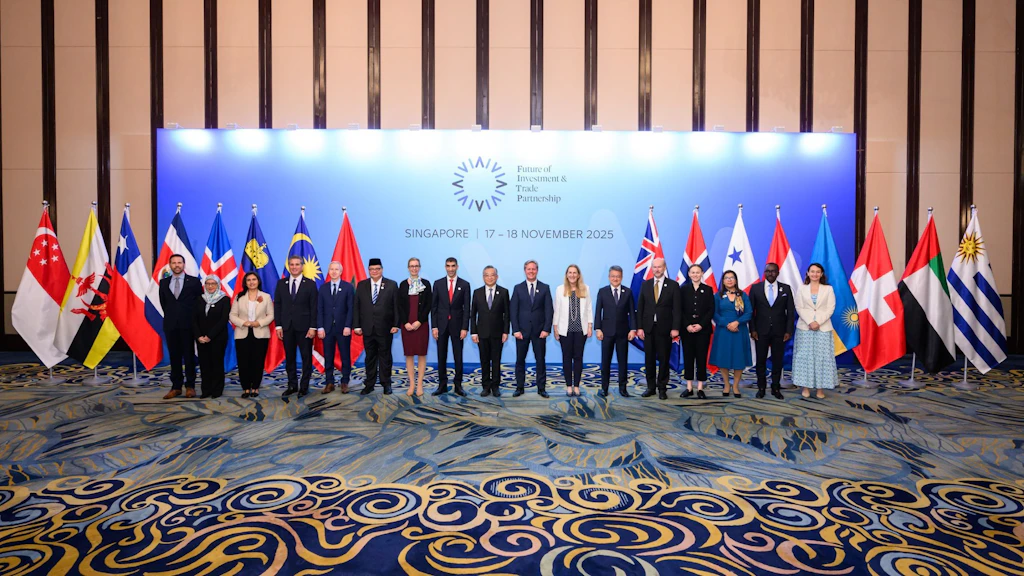
On 18 November 2025, FIT Partnership members held their first ministerial meeting in Singapore, at which Malaysia and Paraguay were welcomed as new members. Several members issued a Ministerial Declaration on Supply Chain Resilience: Best Practices in Response to Major Supply Chain Disruptions, aimed at improving international coordination in managing severe disruptions to global supply chains. Switzerland played a leading role in drafting this declaration.
Further information
Index
Press releases
Switzerland is committed to strengthening the rules-based multilateral trading system
16.03.2026
First ministerial meeting of the Future of Investment and Trade Partnership: Switzerland promotes open markets
18.11.2025
Switzerland takes new steps to diversify its trade relations
16.09.2025
Related topics

Multilateral economic relations
Switzerland actively promotes an open, fair, and rules-based trading system, strengthening transparent trade rules and international cooperation through the WTO, the OECD, and new partnerships.

World Trade Organization (WTO)
Through clear rules, dispute settlement and support for developing countries, the WTO works to make world trade more open, transparent and fair.
European Free Trade Association (EFTA)
Founded in 1960, EFTA has evolved from a tariff-reduction initiative into a key platform for the joint negotiation of modern free trade agreements.
Contact
Foreign Economic Affairs Directorate
World Trade / Multilateral Economic Relations Division
Holzikofenweg 36
3003 Bern