
Purpose and development of the Guidelines
The OECD Guidelines are recommendations by OECD member states and other countries to multinational enterprises on responsible business conduct. They apply globally, regardless of where business is conducted, and cover areas such as human rights, labour rights, the environment, anti-corruption, consumer interests, transparency, technology, competition and taxation.

The OECD Guidelines are not legally binding but serve as an important instrument for responsible globalisation. Their aim is to strengthen investment and trade in relation to sustainable development. Each signatory state establishes a National Contact Point to promote implementation of the recommendations and initiate informal mediation in cases of alleged violations against the Guidelines.
The Guidelines form part of the OECD Declaration on International Investment and Multinational Enterprises. They were updated in 2022/23 to align them with international instruments such as the UN 2030 Agenda. Switzerland supported the update particularly in areas such as supply chain due diligence, climate change, biodiversity, corporate integrity and digitalisation. The OECD's institutional stakeholder bodies, representing the interests of business, trade unions and NGOs, were closely involved in the update. The process also included two public consultations open to interested parties from all countries.
In 2023, the OECD published a Recommendation on the role of governments in promoting responsible business conduct, setting out how states can shape their policies, provide targeted incentives for business and lead by example through their own commercial activities.
The OECD marked the 50th anniversary of the Guidelines in 2026 with the Global Forum on Responsible Business Conduct and published a report with the latest findings. High-level participants discussed policy frameworks for creating fair conditions for business and society, and the role of due diligence in building resilient supply chains amid geopolitical and technological disruption. Switzerland will also mark the anniversary of the Guiding Principles at the 2026 Swiss Forum on Business and Human Rights.
Press releases
Responsible Business Conduct: OECD gives Switzerland high marks
17.6.2026
OECD launches updated guidelines on responsible business conduct
08.06.2023
Federal Council moves to update OECD Guidelines for Multinational Enterprises
22.06.2022
Related topics
.jpeg?rect=54%2C0%2C3447%2C1939&w=1024&auto=format)
National Contact Point for Responsible Business Conduct
The NCP promotes awareness of the OECD Guidelines for Responsible Business Conduct among interested parties and acts as an out-of-court mediation body.

Corporate Sustainability CSR
Corporate sustainability encompasses the impact of business activities on society and the environment. It is regarded as a contribution to sustainable development.
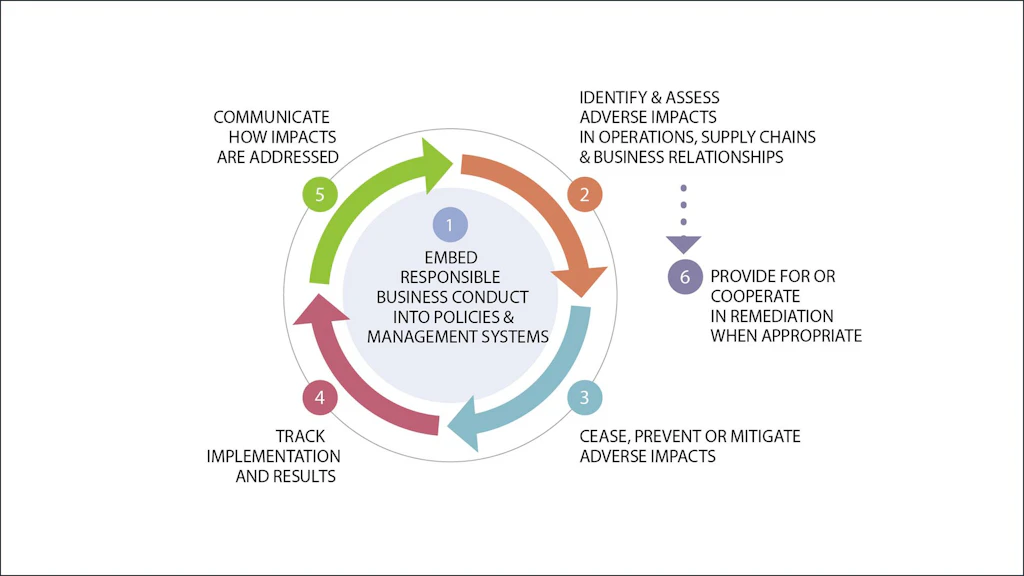
OECD due diligence guidance
The guidances help companies to carry out risk-based due diligence in order to address potential adverse impacts arising from their operations, supply chains and business relationships.
Contact
Foreign Economic Affairs Directorate
Special Foreign Economic Service / International Investment and Corporate Sustainability
Holzikofenweg 36
CH - 3003 Bern