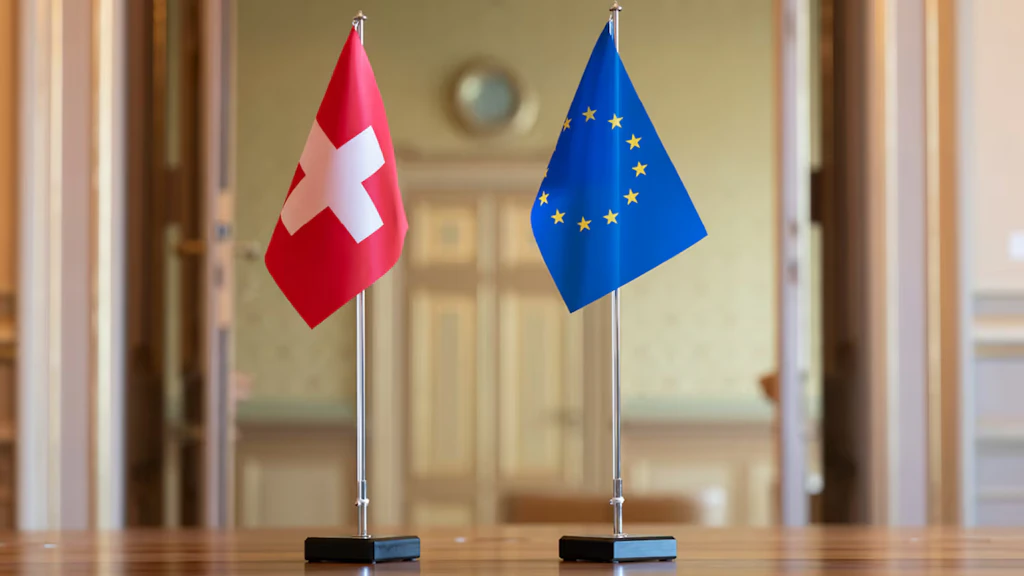
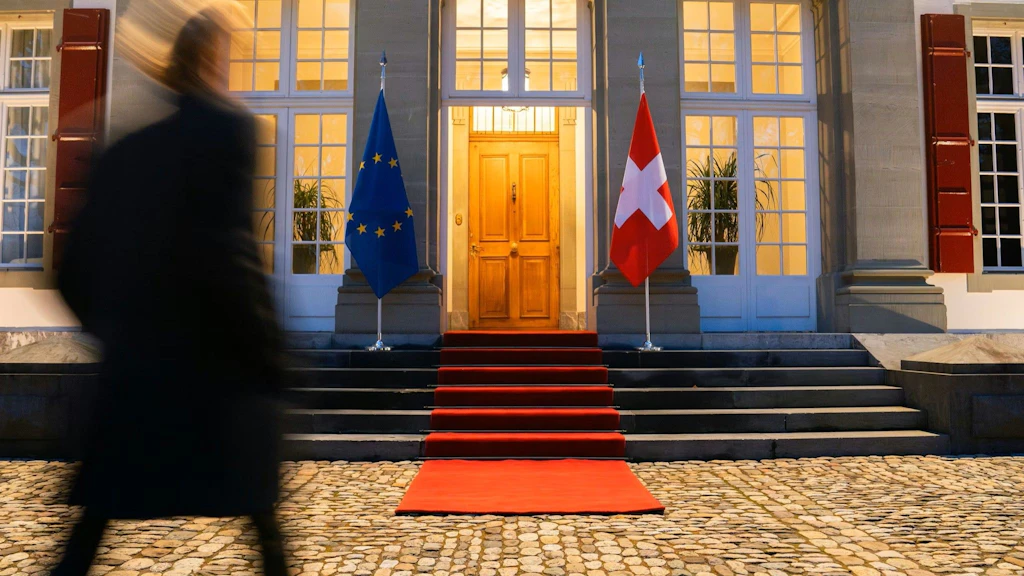
The EU is by far Switzerland’s most important trading partner. An active European policy is therefore of crucial importance from an economic point of view.
As a non-EU member, Switzerland’s relations with the EU are governed by a series of bilateral agreements concluded in several stages since the 1972 Free Trade Agreement. Following the rejection of accession to the European Economic Area (EEA) in the 1992 referendum, Switzerland and the EU signed the Bilateral Agreements I (seven agreements) in 1999 and the Bilateral Agreements II (nine agreements and an exchange of letters) in 2004. These agreements enable Switzerland to participate in the EU single market in various areas, thereby reducing or removing trade barriers in mutual economic exchanges. They also form the basis for close cooperation in areas such as research, security, asylum, the environment and culture.
Package ‘Stabilisation and further development of relations between Switzerland and the EU (Bilaterals III)’
On 13 March 2026, the Federal Council adopted the package “Stabilisation and further development of relations between Switzerland and the EU (Bilaterals III)” and submitted it to Parliament. With this proposal, the Federal Council aims to stabilise and further develop the tried-and-tested bilateral approach. The package ensures the continuity of economic, scientific and social relations with the EU, Switzerland’s most important trading partner. In view of the tense geopolitical situation, stable and reliable relations with neighbouring European countries are of strategic importance.
Economic impact of discontinuation of first package of bilateral agreements (Bilaterals I)
The economic impact of a discontinuation of the Bilateral Agreements I was examined by two research institutes, Ecoplan and BAK Economics, on behalf of SECO. The studies show that a discontinuation would lead to significantly weaker economic growth in Switzerland. Added to this would be losses such as a loss in legal certainty and a decline in the country’s attractiveness as a business location.
On behalf of SECO, Ecoplan has updated its 2015 study in 2025 and and adjusted the model simulation for the period 2028 to 2045. Compared to the first Ecoplan study (2015), the update takes into account Brexit, changes in trade flows and current population scenarios. The study simulates the discontinuation of the Bilateral Agreements I prior to their update by the Switzerland–EU package. The scenario of a complete discontinuation of Bilateral Agreements I was chosen in order to be able to indirectly estimate the economic value of the stabilisation part of the Switzerland–EU package. The scenario is based on plausible assumptions. What would actually happen if the Switzerland–EU package were rejected depends on political decisions and cannot be predicted. Ecoplan's updated model calculations on the previous Bilateral Agreements I confirm the high value of Bilateral Agreements I and of Switzerland's association with EU research and innovation programmes for the Swiss economy. According to the model calculations, if the Bilateral Agreements I were to be discontinued and Switzerland's participation in EU research and innovation programmes were to be downgraded to the status of a non-associated third country, GDP in 2045 would be 4.90% lower than with functioning agreements and the association.
The current studies underscore the findings of the existing literature that the discontinuation of the Bilateral Agreements I would result in significant changes to the economic framework conditions and have negative effects on the Swiss economy.
In 2020, a 2015 study by BAK Economics was also updated on behalf of the St. Gallen-Appenzell Chamber of Commerce and Industry and the Thurgau Chamber of Commerce and Industry:
The 1972 Free Trade Agreement (FTA) liberalises trade in industrial products between Switzerland and the EU. Industrial products originating in the territory of the two contracting parties can be traded duty-free under the FTA. The agreement also prohibits quantitative trade restrictions (quotas) and measures having equivalent effect. Protocol No. 2 of the FTA further regulates trade in processed agricultural products. The FTA is of central importance for Switzerland’s trade relations with the EU, its most important economic partner.
The Agreement on certain aspects of government procurement of 1999 extends the scope of the WTO Agreement on Government Procurement (GPA) in bilateral relations between Switzerland and the EU. The 1999 agreement states that, within the framework of relations between Switzerland and the EU, the WTO rules shall also apply to purchases made by the regional and communal authorities, public and private passenger railway operators, public and private enterprises involved in supplying gas or heat, and private companies that provide a public service on the basis of exclusive rights and which are active in the sectors of drinking water, electricity, urban transport, airports and maritime or inland ports. This agreement opens up important additional opportunities for Swiss suppliers to access public tenders in the EU.
Since the Agreement on mutual recognition in relation to conformity assessment (MRA) came into force in 2002, technical barriers to trade have been removed for numerous industrial sectors. Mutual recognition is based on equivalent technical requirements. By eliminating the need for two conformity assessments, the agreement removes an important barrier to trade. The MRA also helps to avoid other cumbersome administrative requirements for companies, such as the appointment of an authorised representative and the marking of the product with that representative’s contact details. In the product sectors covered by the agreement, companies benefit from cost savings and save time when launching new products at the European level. The agreement strengthens and simplifies cross-border production and distribution chains, thereby contributing to lower prices in Switzerland. As product regulations are constantly evolving, the MRA must be updated regularly. However, in view of the open institutional issues within the broader Switzerland-EU context, the EU has not been willing since May 2021 to proceed with updating the agreement in the field of medical devices.
The new institutional elements in the Switzerland-EU package are also intended to apply to the MRA and enable regular updates to this agreement.
The 1999 Agreement on trade in agricultural products facilitates trade in agricultural products between Switzerland and the EU. It grants tariff concessions (import quotas and tariff reductions) for selected basic agricultural products and reduces non-tariff barriers to trade in the areas of plant health (Annex 4), animal feed (Annex 5), seed (Annex 6), wine and spirits (Annexes 7 and 8), organic products (Annex 9), fruit and vegetables (Annex 10), as well as animals, animal products and foodstuffs of animal origin (Annex 11). The veterinary agreement of 2009 complements these provisions. In 2009, Annex 11 was expanded and a common veterinary area was established. As a result, border controls within the scope of Annex 11 have largely been abolished, significantly facilitating trade in foodstuffs and animal products.
The Food Safety Agreement under the Switzerland–EU package (Bilaterals III) aims to extend the scope of the Agreement on trade in agricultural products and establish a common Switzerland–EU food safety area. It will also regulate trade in non-animal foodstuffs and the authorisation of plant protection products. Switzerland will thereby obtain the desired access to the European Food Safety Authority (EFSA) and the relevant EU networks. In addition, Switzerland will now be included in the EU system for the authorisation of plant protection products.
In addition, an agreement on the mutual recognition of protected designations of origin (PDOs) and protected geographical indications (PGIs) for agricultural products and foodstuffs has been in place since 2011. The EU is also Switzerland’s main trading partner for agricultural products. Two thirds of Switzerland’s agricultural foreign trade is conducted with the EU. The agreement has created new opportunities for Switzerland to export its agricultural products. Since its entry into force, agricultural exports have developed positively overall, particularly in the cheese sector.
The 1999 Agreement on the Free Movement of Persons (AFMP) and its protocols make it easier for Swiss and EU nationals to live and work in each other's territories. In addition to the free movement of labour, the agreement provides for the mutual recognition of professional qualifications and the coordination of social security systems. The same rules also apply between Switzerland and the member states of the European Free Trade Association (EFTA). The AFMP makes it easier for Swiss companies to recruit workers from the EU/EFTA zone, and thus plays a significant role in maintaining Switzerland’s competitiveness as a business location and in boosting economic and job growth.
Accompanying measures The introduction of the free movement of persons was accompanied by the implementation of measures designed to protect workers from the undercutting of wages and employment conditions that are customary in Switzerland.
Trade relations between Switzerland and the EU in the services sector are governed at international level by the General Agreement on Trade in Services (WTO), the Agreement on Direct Insurance and the Bilateral Agreements I (free movement of persons, civil aviation and overland transport).
Switzerland’s preferential relationship with the EFTA states regarding trade in services is established under the EFTA Agreement of 21 June 2001. Article 29 of the agreement prohibits any restriction on the right of a service provider from an EFTA state to provide services in the territory of another EFTA state. Article 20 deals specifically with the free movement of natural persons.
Given the closely linked nature of the Swiss and EU economies, anti-competitive practices often affect both jurisdictions. In these cross-border cases, however, competition authorities encounter difficulties in enforcing competition law, as their jurisdictional reach is generally restricted to their national territory. At the international level, it is now widely accepted that effective cooperation between competition authorities helps ensure better protection of competition. The Agreement between the EU and Switzerland concerning cooperation on the application of their competition laws, concluded on 17 May 2013, aims to strengthen cooperation between the competition authorities of the two parties. The agreement improves the implementation of competition law by enabling the two parties to exchange information on cross-border cases and coordinate their processes.
The Agreement on linking emissions trading systems (ETS), ratified by Switzerland and the EU in December 2019, entered into force on 1 January 2020. Negotiations on linking the trading systems for greenhouse gas emission allowances first began in 2011. Specifically, linking the two systems allows Switzerland to participate in the European emissions trading market, thus enabling companies covered by the ETS to reduce their emissions at a lower cost. This creates a level playing field as large Swiss emitters now pay the same carbon prices as their European competitors. In addition to environmental benefits, this linking of the two ETS also has economic advantages: it enables companies participating in the Swiss system to trade emissions on the larger European market. The emissions generated by civil aviation activities are also to be incorporated into the Swiss ETS, thus bringing it into line with that of the EU. Moreover, this linking of the Swiss ETS with that of another state was the first agreement of its kind and an essential step in exempting Switzerland from the EU’s Carbon Border Adjustment Mechanism (CBAM). The ETS agreement is affected by developments in the EU's climate policy. This means that the Swiss ETS must be continuously reviewed and amended, if necessary
As part of its Emissions Trading System (EU ETS), the EU is progressively reducing from 2026 onwards, the free allocation of emission allowances to high-emission installations such as steelworks, aluminium smelters and cement plants. In parallel, it has introduced a Carbon Border Adjustment Mechanism (EU CBAM).
State aid involves the state granting advantages to individual companies. This can result in unfair distortions of competition. Nevertheless, state aid may be desirable, particularly for political reasons, for example to support a structurally weak region or promote environmentally friendly technologies. To balance such interests, the EU systematically monitors state aid in its Member States. Under the Switzerland–EU package, Switzerland undertakes to adopt the substantive provisions of EU state aid law, limited to the scope of the air transport, land transport and electricity agreements. The monitoring of Swiss state aid in the relevant sectors is to be ensured through its own, equivalent procedure.
The second Swiss contribution 2019–29 to selected EU member states forms part of Switzerland’s European policy; it consolidates the basis for solid economic and political relations with the EU and strengthens Switzerland’s bilateral relations with its partner states. The contribution is an investment in security, stability and prosperity in Europe and aims to reduce economic and social inequalities; it is also intended to help manage migration flows more effectively. The second Swiss contribution, amounting to 1.3 billion Swiss francs, followed the “Cohesion Billion” of 2007. The cohesion contribution is intended for the 13 countries that have joined the EU since 2004. It also supports measures in individual EU member states that are particularly affected by migration flows. The supported programmes, which are co-financed by the partner countries at a rate of 15 per cent, allow Switzerland to promote partnerships with Swiss stakeholders, particularly in the form of advisory services and expertise. An agreement establishing a legally binding mechanism for a regular Swiss contribution to reducing economic and social disparities within the EU forms part of the Switzerland–EU package (Bilaterals III).
The instruments of European Territorial Cooperation (ETC) – such as Interreg – form the cross-border component of EU regional policy. The aim of ETC is to promote the economic, social and environmental development of the EU and its neighbouring countries across borders. Switzerland has been participating in ETC since 1990; since 2008, the Confederation and the cantons have been supporting Swiss participation within the framework of the New Regional Policy (NRP).
Interreg (available in German, French and Italian)
Federal Council adopts the ‘Stabilisation and further development of Swiss–EU relations’ package
13.03.2026
Related topics
Switzerland's European policy
Given the close ties Switzerland maintains with its European neighbors, it is crucial for the country to pursue a concerted and targeted policy that serves its interests vis-à-vis the EU and the European countries.
Swiss-US trade relations
Following the lifting of the country-specific additional tariffs by the US Supreme Court, the US President introduced a new across-the-board additional tariff of 10% citing a different legal basis.
Country Cockpit
The Country Cockpit provides a compact overview of the economic situation and bilateral economic relations of Switzerland's economic partners.
Contact
State Secretariat for Economic Affairs SECO Holzikofenweg 36 CH - 3003 Bern